



THANK YOU FOR SUBSCRIBING
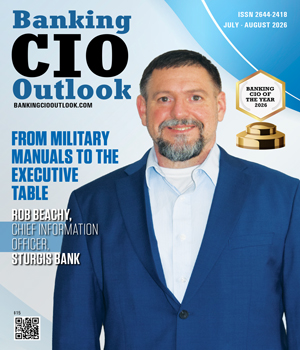
Rob Beachy, CIO of Sturgis Bank, rose from military IT beginnings to executive leadership. He operationalizes the bank’s identity as a “technology company that does banking,” driving efficiency, innovation, AI governance and customer focused community banking. Future Proofing Community Banking My path to becoming Chief Information Officer at Sturgis Bank is anything but conventional. My first real encounter with technology came at my final military duty station, where a sergeant major handed me a stack of manuals and told me to figure it out. From those early Windows 3.11 days, I taught myself networking through persistence, curiosity and asking the right questions. That military ethos of resourcefulness and missionfirst thinking became the foundation of a career spanning more than two decades in banking technology. After leaving the service, I moved into consulting, where I worked across legal, medical and manufacturing environments and learned how businesses operate, not just how their systems run. When Sturgis Bank, already one of my consulting clients, offered me a role, I started as an IT coordinator who could not even place an order without permission. Twenty years and 58 efficiency projects later, I sit at the executive table alongside CEO Jason Hyska, helping shape the bank’s strategy, competitive positioning and growth. That seat reflects a deliberate institutional choice. Sturgis Bank defines itself not as a financial institution that uses technology, but as a technology company that does banking and I am responsible for making that identity operational. Just as important, we are a community bank. That means knowing a customer by name, not account number, staying deeply embedded in the towns we serve and building relationships that large institutions often cannot replicate at scale. Technology at Sturgis Bank is not meant to distance us from that model, but to protect and strengthen it. The CIO Who Still Answers Calls Under my
Mitchell Fleming, Founder and CEO
Businesses operating in digital and multi-channel environments often encounter limitations in payment processing systems that were not designed for scale. Inconsistent approvals, fragmented integrations and limited visibility into transaction performance can restrict revenue and create operational inefficiencies. Optec Payments addresses this challenge by positioning payments as an integrated infrastructure layer rather than a standalone function. Its approach focuses on aligning payment architecture with how businesses generate and manage revenue. “We focus on building a scalable payment architecture that aligns with how businesses actually generate revenue,” says Mitchell Fleming, founder and CEO. Aligning Payment Architecture with Business Needs A recurring issue for businesses is the lack of flexibility in payment processing systems. Many operate with fixed acquiring relationships and limited routing capabilities, which can lead to inconsistent transaction approvals and reduced efficiency across different payment channels. Optec Payments addresses this through processor-agnostic flexibility and intelligent routing. By matching merchants with acquiring partners based on transaction characteristics, risk profile and growth objectives, it enables more consistent authorization outcomes and improved transaction performance. The company also emphasizes structured underwriting and transparency in pricing. This allows businesses to better understand the economics of their payment systems while ensuring that risk is managed effectively. The result is a more predictable and scalable payment environment that supports long-term growth and operational clarity. Integrating Security, Visibility and Control Payment systems often suffer from fragmented integrations and limited data visibility, making it difficult for businesses to monitor performance and manage risk effectively. Optec Payments addresses this through a layered architecture that integrates authorization, security and real-time monitoring into a unified system.

Mobile Payment

Kenny Moyer, VP & Director of Operations, Memory Bank
Payment and Card

Mark Sanchioni, Chief Banking Officer, Ridgewood Savings Bank
Embedded Finance

Chad A. Schmookler, Vice President Business Operations, InComm
FinTech

Jimmy Stead, Chief Consumer Banking and Technology Officer at Frost.
Retail Banking

Chris Lee, Chief Financial Officer, Gate City Bank

Michael Lawson, Vice President, Security & Loss Prevention Officer, BSA Officer, Artisans Bank

Banking Customer Experience
Brian A. Voss, Senior Vice President, Regional Director, NBT Capital Management
AML solutions strengthen compliance, risk detection, fraud prevention, and financial transparency across institutions.
Intelligent recovery platforms combine predictive analytics, automation, personalized communication, compliance support and integrated workflows to improve collections while strengthening lasting customer relationships.
Banking on Innovation and Lasting Trust
Featured on the cover, Rob Beachy, Chief Information Officer at Sturgis Bank, has earned recognition as the Banking CIO of the Year 2026. Drawing on a career shaped by military discipline and more than two decades in banking technology, Beachy has positioned technology as a strategic driver of community banking. Through AI governance, automation and API-driven innovation, he has helped streamline operations while strengthening the personal relationships that define Sturgis Bank's 120-year legacy. His leadership demonstrates that the most effective technology initiatives are those that improve customer service, empower employees and reinforce the human side of banking.
This edition also recognizes Optec Payments, named Top Payments Processing Solution 2026, for helping businesses transform payment processing into a scalable, data-driven infrastructure. Its flexible payment architecture, intelligent transaction routing and integrated security capabilities enable organizations to improve authorization rates, strengthen compliance and support long-term revenue growth in an increasingly digital marketplace.
This issue also features perspectives from industry leaders. Jimmy Stead, Chief Consumer Banking and Technology Officer at Frost, shares how meaningful innovation begins with culture, emphasizing investments in people, technology and customer experiences to deliver long-term value. Brian A. Voss, CEO of Columbia Ridge Capital Management, explores how banks can combine data, technology and human expertise to anticipate customer needs and deliver more personalized financial experiences.
As banking continues to evolve, the organizations and leaders featured in this issue demonstrate that lasting success comes from combining innovation with trust, operational excellence and customer focus. We invite you to explore their stories and discover the ideas shaping the future of modern banking.

Banking CIO Outlook Weekly Brief
Be first to read the latest tech news, Industry Leader's Insights, and CIO interviews of medium and large enterprises exclusively from Banking CIO Outlook
